

Medically reviewed by Scott Vizzi, MD | Reviewed June 2026
Shoulder impingement syndrome is a common condition I see in St. Petersburg and Largo. And yet, despite how frequently it comes up, there’s a lot of confusion about what it actually means. Patients often come in after weeks of googling their symptoms, worried they need surgery when, in many cases, they don’t. Understanding shoulder impingement, including what it is, why it happens, and how it gets treated, can make a real difference in how you approach your own recovery.
Key Takeaways
- Shoulder impingement syndrome occurs when tendons in the shoulder get compressed beneath the acromion during arm movement.
- It’s one of the most common causes of shoulder pain in active adults, overhead workers, and athletes.
- Most cases respond well to non-surgical treatment, including physical therapy and targeted strengthening.
- When symptoms don’t improve with conservative care, surgical options are available.
What Shoulder Impingement Actually Means
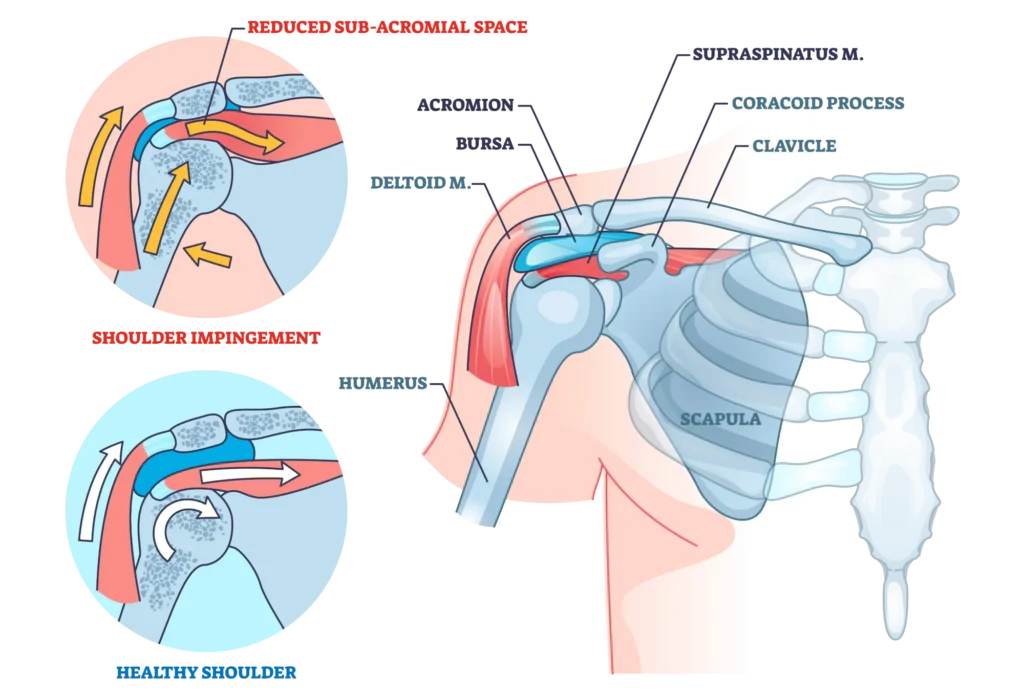
The shoulder is designed to move in almost every direction, and that range of motion depends on several structures working together. One of the most important is the rotator cuff, a group of four tendons that wrap around the shoulder joint and help stabilize and move the arm. Above those tendons sits a bony arch called the acromion, which is part of the shoulder blade.
Between the rotator cuff tendons and the acromion lies a small, fluid-filled cushion called the bursa. Under normal circumstances, there’s enough space for everything to move smoothly. But when that space narrows because of inflammation, bone shape, posture changes, muscle imbalances, or repetitive motion, the tendons and bursa can get pinched, or “impinged,” during arm movement.
That compression is what we call shoulder impingement syndrome (or subacromial pain syndrome). The result is pain, often dull and aching, that tends to show up on the outer side of the shoulder and upper arm. It usually gets worse when you lift your arm overhead or reach out to the side. Many patients also report night pain, particularly when rolling onto the affected shoulder in bed.
Who Gets It and Why
Shoulder impingement is not a condition exclusive to athletes. I see it in people across a wide range of lifestyles. That said, certain patterns do tend to come up over and over.
Overhead athletes are at higher risk, particularly swimmers, tennis players, baseball pitchers, and volleyball players. Here in the Tampa Bay area, where water sports and tennis are part of everyday life for a lot of people, impingement comes up frequently in my practice. The repetitive overhead demands of those activities can gradually wear on the subacromial space and surrounding soft tissue.
People who perform repetitive overhead work, such as painters, electricians, or construction workers, are also at elevated risk. Desk workers and people with forward-leaning posture can develop it too, since slouching changes the alignment of the shoulder blade and can reduce the available space for the rotator cuff tendons.
Structurally, some people are just built with a smaller subacromial space, or they have what’s called a “hooked” acromion, which projects downward and leaves less room for the tendons below. That doesn’t mean impingement is inevitable, but it does mean certain activities may carry more risk.
What Patients Tend to Tell Me
The presentation of shoulder impingement is fairly consistent in my clinic. Most patients describe a gradual onset of pain, not a single dramatic injury. They notice discomfort when reaching overhead, like when putting something in a cabinet or washing their hair. Some describe a painful arc, or a range of elevation where the pain is worst before easing slightly at full overhead reach.
Night pain is a common complaint that I take seriously. When patients tell me they can’t sleep on their affected side, or that they wake up from pain, I know the condition is affecting their quality of life in a meaningful way.
Weakness is another factor. Some patients notice they struggle to lift the arm against resistance or that their shoulder fatigues more quickly than usual. Weakness in impingement can come from pain inhibition, where the body subconsciously avoids using the arm to protect against discomfort, and it can also reflect rotator cuff involvement if the tendons are irritated or partially torn.
One thing I find in my experience working with athletes, including my work with the Toronto Blue Jays, is that overhead athletes sometimes push through early symptoms far longer than they should. A pitcher with impingement will often adapt their mechanics to compensate, which can create downstream problems. Catching the diagnosis early matters.
Diagnosis: What to Expect
Getting an accurate diagnosis is the foundation of any good treatment plan. When a patient comes in with suspected shoulder impingement syndrome, I start with a thorough conversation: when the pain started, what makes it better or worse, what activities are affected, and whether there was any injury that triggered it. That history often tells me a lot before I even lay a hand on the shoulder.
The physical exam involves testing range of motion, identifying areas of tenderness, and using specific provocation tests that stress the subacromial space to reproduce symptoms. X-rays give me a look at the bony structures, including the shape of the acromion and whether there are any calcium deposits or arthritic changes contributing to narrowing. If I’m concerned about rotator cuff involvement or need a clearer picture of the soft tissue, I’ll order an MRI. For most straightforward presentations of shoulder impingement, a standard MRI provides good information. If there’s any reason to suspect associated labral pathology or more subtle tissue changes, I may consider an MRI arthrogram, which involves injecting a small amount of contrast to improve visualization inside the joint.
My Approach to Treatment
My starting point with shoulder impingement is almost always conservative. Surgery is rarely where I want to go first, and honestly, most patients don’t need it. In my experience, a well-structured non-operative program resolves a significant portion of cases.
Physical therapy is the cornerstone of that approach. The goal is not just pain relief but addressing whatever created the problem in the first place. That means correcting posture and movement mechanics, strengthening the rotator cuff and the muscles that control the shoulder blade (scapular stabilizers), and improving overall shoulder kinematics. Therapy that focuses only on pain management without addressing mechanics tends to produce short-term results at best.
Anti-inflammatory medications can help reduce swelling and make it easier to participate in therapy. I sometimes use a corticosteroid injection to quiet down significant inflammation when it’s getting in the way of progress, though I don’t rely on injections as a standalone solution. For patients who want to explore options beyond traditional anti-inflammatories, PRP therapy may be something I discuss as part of my broader approach.
Activity modification also matters. I ask patients to identify and temporarily reduce the specific movements driving their symptoms while we work on the underlying mechanics.
If someone has been through a dedicated course of physical therapy, done everything right, and their symptoms genuinely haven’t improved, then surgical evaluation may be a reasonable next step. Shoulder arthroscopy may be used to decompress the subacromial space, remove inflamed bursal tissue, and address any structural contributors to the impingement. It’s a minimally invasive procedure. Recovery depends on what exactly is addressed.
Summary
Shoulder impingement syndrome is a common condition. If you’re dealing with that aching shoulder pain that flares with overhead activity or wakes you up at night, don’t assume surgery is in your future. In many cases, it isn’t. What I’d recommend is getting evaluated sooner rather than later, because the longer impingement goes unaddressed, the more it can affect your mechanics, your strength, and, in some cases, the rotator cuff tendons themselves.
If you’re in the St. Petersburg, Largo, Palm Harbor, or Sarasota area and shoulder pain is interfering with your daily activities, I’d encourage you to schedule a consultation and let’s take an honest look at what’s going on.
Frequently Asked Questions
What is the difference between shoulder impingement and a rotator cuff tear?
They’re related but not the same thing. Shoulder impingement describes compression of the tendons and bursa in the subacromial space, which causes pain and inflammation. A rotator cuff tear refers to structural damage (an actual partial or complete disruption in the tendon tissue itself). Long-standing, untreated impingement can contribute to tendon wear over time, which is one reason addressing impingement early is worthwhile. Both conditions can cause similar symptoms, and it’s possible to have both at the same time, which is part of why imaging is often helpful in reaching an accurate diagnosis.
How long does it take to recover from shoulder impingement syndrome?
It varies depending on severity, how long the condition has been present, and how well a person engages with their physical therapy program. Some patients see improvement within 6 to 8 weeks of consistent treatment. Others with more chronic or severe presentations may need 3 to 6 months to reach a satisfying level of function.
Do I need surgery for shoulder impingement?
Many people don’t. The majority of shoulder impingement cases respond well to conservative treatment, primarily physical therapy. Surgery becomes a consideration when a patient has completed an appropriate non-operative program without meaningful improvement, or when imaging reveals structural contributions that are unlikely to resolve on their own. I evaluate each case individually and am upfront about when I think surgery makes sense and when I think it doesn’t.
What can make shoulder impingement worse?
Continued overhead activity without addressing mechanics, poor posture, skipping physical therapy, and relying solely on medications or injections without working on the underlying issues can all slow recovery. Sleeping on the affected side consistently can also aggravate symptoms. Identifying and modifying the specific habits or activities driving the problem is part of the recovery process.