
Medically reviewed by Scott Vizzi, M.D. | Reviewed August 2026
A cyclist goes over the handlebars and lands square on the point of the shoulder. A linebacker takes a direct hit while his arm is pinned at his side. Both mechanisms frequently lead to the same place in my office: an AC joint injury. AC joint injuries in athletes are some of the most common shoulder injuries I see after a fall or a direct blow, and the range of severity, from a mild sprain to a fully separated shoulder, surprises a lot of patients who assume every AC injury needs surgery.
Key Takeaways
- AC joint injuries in athletes range from mild ligament sprains to complete separations, and severity is graded on a scale that guides treatment.
- The mechanism is often a direct blow to the top of the shoulder or a fall onto an outstretched arm.
- Most lower-grade AC joint injuries heal well without surgery. Higher-grade separations, where the collarbone shifts noticeably out of position, may benefit from surgical stabilization.
What the AC Joint Does, and How It Gets Injured
The acromioclavicular joint, or AC joint, sits where the collarbone meets the top of the shoulder blade at a bony landmark called the acromion. It’s a small joint, held together by a set of ligaments, but it plays an important stabilizing role every time the arm moves overhead or across the body.
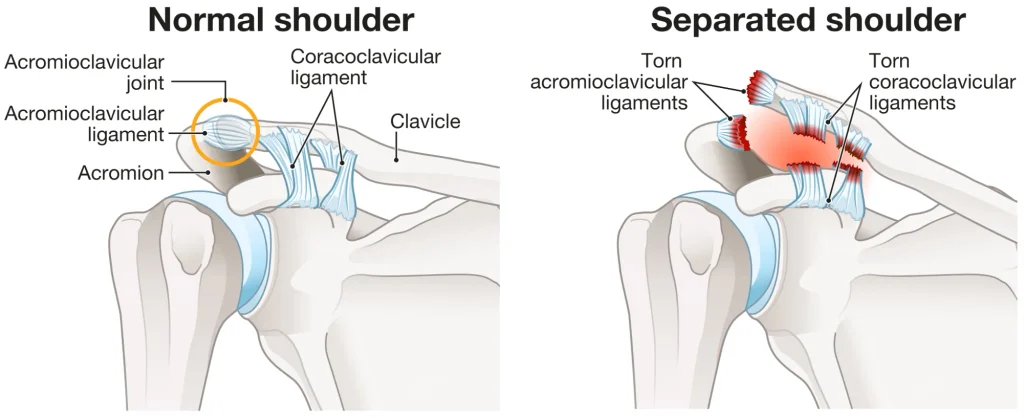
Most AC joint injuries happen from a direct impact to the top of the shoulder, common in football, hockey, rugby, and cycling falls, or occasionally from landing on an outstretched hand. The force drives the shoulder blade downward relative to the collarbone, stretching or tearing the ligaments that hold the joint together. How much those ligaments give way determines the grade of injury.
Understanding the Grading System
AC joint injuries are typically classified using a grading system that runs from Type I through Type VI, though the majority of athletes I evaluate fall into the lower three grades. A Type I injury is a mild sprain with the ligaments stretched but largely intact and the joint still aligned normally. A Type II involves a partial tear with some joint widening. A Type III represents a complete tear of the main stabilizing ligaments, with the collarbone visibly displaced upward relative to the shoulder blade.
Higher grades, Type IV through VI, involve more significant displacement of the collarbone, sometimes behind or beneath surrounding tissue, and are less common. These usually warrant a closer surgical discussion given how far out of position the joint has shifted.
Why Grading Isn’t Always Straightforward
Grading an AC joint injury sounds simple on paper, but in practice it isn’t always a clean call. Swelling in the first day or two after injury can mask how much the joint has shifted, which is part of why I sometimes recommend a follow-up exam or repeat imaging once the initial inflammation settles. I’ve seen injuries that looked like a moderate Type II on the first visit reveal themselves as a Type III once swelling resolved and the true position of the collarbone became clear.
Comparison views of the uninjured shoulder can also help clarify borderline cases, since normal anatomy varies somewhat from person to person.
What I See in My Patients
Between the cycling community along the Pinellas Trail and the volume of contact-sport athletes I see from local high school and travel programs, AC joint injuries come through my office pretty often. A lot of athletes assume a visible bump on the collarbone means they need an operation right away, and in most lower-grade cases, that’s simply not true.
What I do think surprises people is how much a Type III injury specifically divides opinion. There’s debate in the literature about whether these moderate separations do better with surgery or with a well-run non-surgical rehab program, and I don’t think there’s a universally correct answer. I make that recommendation based on the individual athlete, their sport, their demands, and how the shoulder is functioning, not off a rigid rule.
I also see a fair number of weekend athletes, recreational cyclists and beach volleyball players in particular, who initially brush off the injury as a bruise. By the time they come in a few weeks later still struggling with overhead reach, the ligaments have often healed in a stretched, less stable position than they would have if treatment had started earlier. That delay doesn’t always change the ultimate outcome, but it can make the early rehab phase more uncomfortable than it needed to be.
My Approach to Treatment
For Type I and Type II injuries, I almost always start non-surgically: a brief period of rest, ice, a sling for comfort, followed by progressive physical therapy focused on restoring motion and then strength around the shoulder girdle. Most athletes with these grades return to sport within a matter of weeks. I’ve also used PRP therapy in select cases to help support ligament healing in this window.
For Type III injuries, I have an honest conversation with each athlete about the tradeoffs. Overhead and throwing athletes, along with those in heavy contact sports, sometimes do better with surgical reconstruction, while others recover perfectly well without it. Type IV through VI injuries, given the degree of displacement involved, more often point toward surgery, frequently performed using minimally invasive techniques to reconstruct the torn ligaments and restore normal alignment.
Recovery and Return to Sport
Timelines can vary between patients, but non-surgical recovery for lower-grade injuries generally allows a gradual return to sport within two to six weeks, depending on the demands of the activity and how quickly strength returns. Surgical reconstruction requires a considerably longer runway, often several months, since the reconstructed ligaments need time to mature before they can tolerate the stress of contact sport or heavy lifting again.
I structure return-to-play around functional milestones, pain-free motion, strength that matches the uninjured side, and confidence with sport-specific movement, rather than a fixed date. Athletes who rush back before those milestones are met run a real risk of re-injury or chronic joint irritation down the line.
Contact athletes deserve a particular note here. Even after a successful non-surgical recovery from a lower-grade injury, I generally want to see solid strength and full confidence in overhead and cross-body movement before clearing someone for full-contact practice, since a second direct hit to an already-stressed joint tends to cause more lasting damage than the first one did.
Summary
AC joint injuries in athletes cover a wide spectrum, from a mild sprain that resolves in a few weeks to a complete separation that may need surgical reconstruction. Getting the grade right through a careful exam, and sometimes imaging, is the foundation for figuring out the right path forward, since treatment genuinely differs across that spectrum.
If you’ve taken a direct hit to the shoulder and noticed swelling, a visible bump, or ongoing pain at the top of the joint, the right next step is getting it evaluated rather than assuming it will settle on its own. Schedule an evaluation so we can determine the grade of injury and build the right recovery plan from there.
Frequently Asked Questions
Do all AC joint injuries need an X-ray?
Imaging is generally helpful to confirm the grade of injury, especially when the exam suggests more than a mild sprain. Weight-bearing or stress views can sometimes help clarify borderline cases.
Will the bump on my collarbone go away?
In higher-grade injuries treated without surgery, some prominence at the joint may persist, even after full functional recovery. It’s usually a cosmetic issue rather than a functional one for most patients.
Can I keep playing with a mild AC joint sprain?
Some athletes with Type I injuries continue with modified activity, but that decision should follow an evaluation rather than guesswork, since a joint that isn’t protected properly can worsen with continued impact.
How soon after injury should I get evaluated?
Sooner is generally better, ideally within the first few days. Early evaluation lets us start appropriate treatment without losing time.