

Shoulder joint pain is one of the most common reasons people visit an orthopedic surgeon, and it’s easy to understand why. The shoulder is the most mobile joint in the entire body, and that mobility makes it incredibly useful. It also makes it vulnerable. A complex web of muscles, tendons, cartilage, and ligaments all work together to keep the joint stable and functional. When any part of that system breaks down, you tend to feel it right away.
Shoulder pain can interfere with the activities you care about most, whether that’s playing a sport, staying active in retirement, or simply getting through a workday comfortably. This post walks through the most common causes of shoulder pain, the diagnostic process, and what treatment options may be available to you.
Key Takeaways
- The shoulder is the most mobile joint in the body, which makes it particularly susceptible to both injury and gradual wear.
- Common causes of shoulder joint pain include rotator cuff problems, arthritis, shoulder impingement, frozen shoulder, and labral tears.
- Many patients experience improvement with non-surgical approaches like physical therapy, anti-inflammatory medications, and corticosteroid or PRP injections.
- When conservative treatment isn’t enough, surgical options, including arthroscopy and shoulder replacement, may be considered.
What Makes the Shoulder So Complex?
To understand why shoulder joint pain is so common, it helps to have a basic picture of how the shoulder actually works. The shoulder is a ball-and-socket joint. The ball is the rounded head of the upper arm bone (humerus), and the socket is a shallow cup on the shoulder blade called the glenoid. This design allows your arm to swing and rotate in nearly every direction.
However, that freedom of movement comes with a structural trade-off. Because the socket is relatively shallow, the shoulder depends heavily on surrounding soft tissue for stability. The rotator cuff, a group of four muscles and their tendons, wraps around the joint and keeps the ball centered in the socket. The labrum, a ring of cartilage at the rim of the socket, helps deepen the cup. Ligaments reinforce the joint from multiple angles, and the bursa, a small fluid-filled sac, cushions the space between the tendons and the bone above.
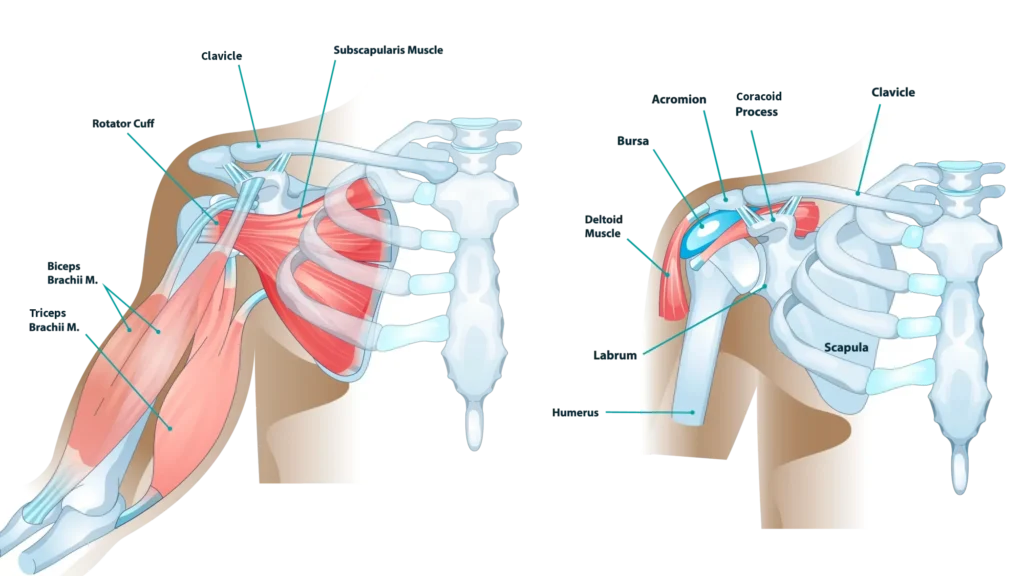
When any of those structures becomes irritated, strained, or damaged, shoulder joint pain may follow. Sometimes the problem involves more than one structure at once, which is part of why shoulder pain can be tricky to pin down without a proper evaluation.
Common Causes of Shoulder Joint Pain
Shoulder pain rarely has a single, obvious explanation. Causes range from acute injuries to conditions that develop gradually over months or even years. Below are some of the most frequently encountered culprits.
Rotator Cuff Injuries
Rotator cuff tears can result from a single traumatic event (like a fall or a sudden pull) or from repetitive overhead activity that slowly wears down the tendons over time. Partial tears may cause a dull aching pain and mild weakness. Full-thickness tears can be more limiting, making it difficult to lift the arm or perform basic tasks. Many people notice that the pain worsens at night, particularly when lying on the affected side.
Shoulder Impingement
Shoulder impingement happens when the tendons of the rotator cuff get pinched between the bones of the shoulder as the arm lifts. It tends to produce a dull, aching pain along the outer edge of the shoulder and upper arm that typically worsens with overhead movements. Impingement is one of the more common causes of shoulder joint pain in active adults and those who perform repetitive overhead work.
Osteoarthritis
Shoulder arthritis develops when the cartilage cushioning the joint gradually breaks down. As that protective layer thins, the bones begin to rub against each other, causing pain, stiffness, and sometimes a grinding sensation during movement. Arthritis in the shoulder is more common in older individuals.
Frozen Shoulder (Adhesive Capsulitis)
Frozen shoulder is a condition in which the lining of the joint gradually thickens and tightens, progressively limiting the shoulder’s range of motion. It typically develops in stages, beginning with increasing pain, progressing to significant stiffness, and eventually improving, though the process can be slow. People with diabetes or thyroid conditions may be at somewhat higher risk.
Labral Tears
The labrum is the cartilage ring that stabilizes the shoulder joint. It can tear from a dislocation, a fall, or repetitive throwing motions common in sports like baseball. Labral tears often produce a deep, hard-to-pinpoint ache inside the joint, along with a sense of instability or a clicking sensation.
AC Joint Problems
The acromioclavicular (AC) joint sits where the collarbone meets the top of the shoulder blade. Falls and contact sports collisions can injure this joint, causing localized pain and sometimes a visible bump at the top of the shoulder. AC joint arthritis can also develop gradually over time.
Symptoms Worth Paying Attention To
Not all shoulder pain requires an urgent trip to a specialist. Some discomfort that follows unusual exertion may settle down with a few days of rest. Consider scheduling a consultation if you notice any of the following:
- Pain that persists despite rest and conservative self-care
- A noticeable decrease in your range of motion, particularly difficulty reaching overhead or behind your back
- Significant weakness in the arm, especially when lifting or rotating
- A popping, clicking, or grinding sensation inside the joint during movement
- Pain that consistently disrupts your sleep or makes it impossible to lie on that side
- Swelling, bruising, or visible deformity following an injury
It’s also worth noting that shoulder joint pain doesn’t always stay where it starts. Pain may radiate down into the upper arm or travel upward toward the neck. This kind of referred pain can make it harder to identify the actual source of the problem without a hands-on evaluation and, often, some imaging.
How Is Shoulder Joint Pain Diagnosed?
A thorough evaluation typically begins with a conversation. An experienced shoulder surgeon will want to understand when the pain started, what makes it better or worse, whether it developed after an injury or gradually over time, and how it’s affecting your daily life. From there, a physical exam assesses your range of motion, identifies areas of tenderness, and uses specific tests to stress different structures and reproduce symptoms.
Following the physical exam, imaging tests may be ordered. X-rays are typically the first step. They are used for identifying bone changes, joint space narrowing from arthritis, calcium deposits, and fractures. For a closer look at soft tissue, such as the rotator cuff, labrum, biceps tendon, and bursa, an MRI is generally more informative. Ultrasound can also be a useful real-time tool for evaluating tendon health.
Treatment Options for Shoulder Joint Pain
The right treatment depends entirely on what’s causing the pain, how severe it is, and how it’s affecting your life. In the following subsections, we’ll review some of the most common treatment options.
Physical Therapy
A targeted physical therapy program of stretching and strengthening exercises may help reduce inflammation, restore range of motion, and support the structures around the joint. Depending on the condition, patients may see meaningful improvement after a consistent course of therapy.
Medications
Anti-inflammatory medications, either over-the-counter options like ibuprofen or prescription alternatives, may help manage pain and swelling in the short term. They work best as one component of a broader plan rather than as a standalone solution, and they’re generally not intended for long-term use without medical supervision.
Corticosteroid Injections
Corticosteroid injections deliver powerful anti-inflammatory medication directly into the joint or surrounding bursa. They may provide meaningful temporary relief and give patients the window they need to make progress with physical therapy. They’re not a cure, but they can be a useful part of managing pain while the underlying issue is addressed.
Platelet-Rich Plasma (PRP) Therapy
PRP therapy is an option some patients explore when conventional treatments haven’t fully resolved the problem. It involves drawing a small amount of your own blood, spinning it down to concentrate the platelets, and injecting that plasma into the affected area. Platelets contain growth factors that may help support the body’s natural healing process.
Surgical Options
When conservative treatment doesn’t provide sufficient relief, or when the underlying problem is severe enough that surgery is the most appropriate path, I offer several options depending on the diagnosis.
Shoulder arthroscopy is a minimally invasive procedure in which the surgeon uses a small camera and specialized instruments, inserted through small incisions, to repair damaged tissue. Common arthroscopic procedures include rotator cuff repair, labral repair, and removal of inflamed tissue.
Total shoulder replacement reconstructs the damaged joint using prosthetic components that replicate the shoulder’s natural anatomy. It’s typically recommended for patients with advanced arthritis who haven’t responded adequately to other treatments.
Reverse shoulder replacement changes the orientation of the ball and socket, which can be particularly effective for patients whose rotator cuff is severely compromised. In these cases, the reverse design allows the deltoid muscle to compensate and restore arm function more effectively than a standard replacement could.
Summary
Shoulder joint pain is incredibly common, but that doesn’t mean you have to live with it. The shoulder is a complex joint, and when something goes wrong, whether it’s a rotator cuff problem, arthritis, frozen shoulder, or a labral tear, the impact can ripple into almost every part of daily life. Treatment options span a wide range. Many patients find real relief through physical therapy, injections, or PRP before ever considering surgery. And when surgery is the right call, today’s minimally invasive techniques and advanced implant systems may offer meaningful outcomes for the right candidates.
Frequently Asked Questions About Shoulder Joint Pain
Can shoulder joint pain go away on its own?
It depends on the cause. Minor soreness from overuse or an awkward movement may improve with rest, ice, and a bit of time. But shoulder joint pain that persists for more than a few weeks, especially when it comes with weakness, limited motion, or nighttime disruption, may be less likely to fully resolve without some form of treatment.
Is it normal to have shoulder pain without any obvious injury?
Yes, and it’s actually quite common. Many cases of shoulder joint pain develop gradually without a single incident to point to. Arthritis, frozen shoulder, and rotator cuff degeneration often build slowly over months or years before they become noticeably painful. The absence of a clear injury doesn’t mean nothing is wrong; it may just mean the problem developed quietly over time.
How long does recovery from shoulder surgery typically take?
Recovery timelines vary depending on the procedure. Arthroscopic procedures may allow patients to return to light activities within a few weeks, though maximal recovery can take several months. Shoulder replacement typically involves a longer rehabilitation process. I discuss realistic recovery expectations with each patient individually, since timelines depend on the surgery, the person’s baseline fitness, and how they progress through rehabilitation.