
Medically reviewed by Scott Vizzi, M.D. | Reviewed May 2026
I work with a lot of athletes: high school players, college competitors, weekend warriors, and professionals. If there’s one condition that tends to catch people off guard, it’s shoulder instability. The shoulder feels fine until it doesn’t. Then, often in the middle of a tackle, a throw, or a swing, the joint shifts, slips, or pops out entirely.
Shoulder instability in athletes is something I see regularly across my practice serving the Tampa Bay area. The cause, the severity, and the right path forward all vary depending on the athlete, their sport, and what’s going on inside the joint. This post walks through what I look for, how I approach treatment, and when surgery may or may not be the right answer.
Key Takeaways
- Shoulder instability in athletes can range from a single traumatic dislocation to chronic, recurring episodes of slipping or looseness.
- Younger, highly active athletes tend to face a higher risk of recurrence after a first dislocation compared to older or less active patients.
- Many patients improve with a structured rehabilitation program, but some may benefit more from surgical stabilization, especially when structural damage increases the likelihood of repeated episodes.
What’s Actually Happening When the Shoulder Feels Unstable
The shoulder is built for range of motion above almost everything else. That’s what makes it so valuable for athletes. It’s also what makes it susceptible to instability.
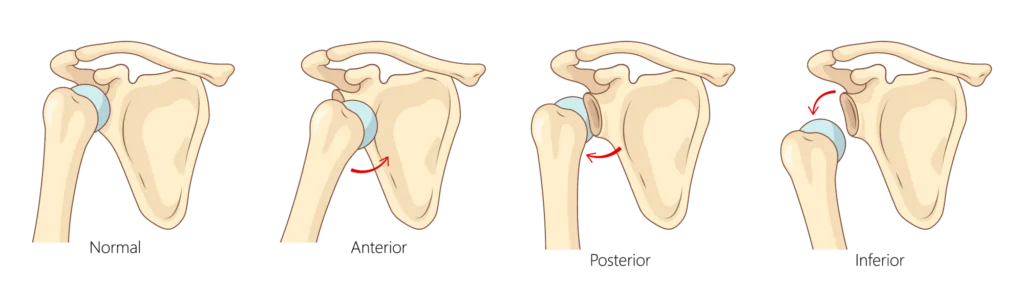
The socket, called the glenoid, is relatively shallow. Think of a golf ball sitting on a tee: if the surrounding structures don’t actively hold it in place, it can easily shift. The labrum, a ring of cartilage around the socket’s rim, deepens that cup and serves as the attachment point for several key ligaments. When the shoulder dislocates or shifts, the labrum is frequently where the damage happens. A Bankart lesion, a tear of the anterior-inferior labrum, is one of the most common findings. It strips the joint of a key part of its passive stabilizing mechanism.
In contact sports, instability usually starts with a single traumatic event. A collision, a fall on an outstretched arm, a block that goes wrong. The shoulder may fully dislocate, or it may partially slip (subluxation) and reduce on its own. Either way, the athlete knows something happened. In overhead athletes like pitchers, volleyball players, and swimmers, instability can develop more gradually through repetitive stress and capsular stretching, even without a clear dislocation event. Both presentations are real, and both deserve proper evaluation.
How I Evaluate Shoulder Instability in Athletes
When an athlete comes into my office with concerns about shoulder instability, I don’t rely on imaging alone. The physical exam tells me a great deal. I look for apprehension, that tense, guarded reaction when I position the arm in a way that mimics the vulnerable position. I test anterior and posterior stability, assess overall laxity, and look for signs of capsular redundancy.
The history matters just as much: how many episodes have there been, what sport and position, did the shoulder reduce on its own or require assistance, and does the athlete feel confident going into contact or overhead positions?
Imaging typically starts with X-rays to assess bony anatomy and screen for a Hill-Sachs lesion (an impression on the back of the upper arm bone) or a bony Bankart (a fragment off the front of the socket). When bone loss is a possibility, CT imaging may provide a more detailed picture. MRI or MR arthrogram helps evaluate the soft tissue, including the labrum and capsule, and can reveal pathology that plain films won’t show.
I’ll also ask about the athlete’s competitive calendar. It’s something my work as a team physician reinforced early on. A college athlete mid-season has different short-term priorities than someone heading into the off-season, and that context shapes the conversation about next steps.
Non-Surgical Management: When It Makes Sense
Not every case of shoulder instability in athletes requires surgery. For a first-time dislocation, especially in older or less active patients, non-operative management is often a reasonable starting point. A brief period of immobilization in a sling comes first. Patients then begin a progressive rehabilitation program targeting rotator cuff strength, scapular stability, and neuromuscular control.
The goal isn’t just building strength in isolation. It’s restoring the dynamic stabilizers: the muscles that actively protect the joint when passive structures like the labrum and ligaments are stretched or damaged. A well-designed program takes several months to complete, and athletes should expect a real commitment to the process.
I’m honest with patients about what the data suggests: younger athletes and those in collision or overhead sports tend to have meaningfully higher recurrence rates after a first dislocation compared to older, less active individuals. For a 17-year-old football player, the likelihood of re-dislocation without surgical stabilization can be substantial. That’s a conversation I have early, because it can influence the decision.
When Surgical Stabilization May Be the Right Call
For athletes with recurrent instability, or when the structural damage from a first event makes re-injury very likely, surgery may offer the best chance at a stable return to sport.
The most common procedure I perform for shoulder instability is arthroscopic labral repair. Through small incisions, I use suture anchors to reattach the torn labrum to the glenoid rim and address any capsular laxity. Because the approach is arthroscopic, it minimizes trauma to surrounding tissue, and the visualization is excellent. I can address additional findings in the same procedure if needed, such as a partial rotator cuff tear, loose bodies, or associated SLAP pathology.
In cases where there’s significant bone loss on the glenoid socket, typically beyond a threshold where a soft-tissue repair alone may not provide enough stability, bony augmentation procedures may be discussed. That situation comes up less frequently, but it does come up in athletes who’ve had multiple dislocations over years without treatment.
Recovery after arthroscopic stabilization starts with a period of sling protection to allow the repaired tissue to heal. After that, patients gradually regain motion, build strength, and advance to sport-specific activity. I don’t clear athletes based on a calendar alone. I use functional testing and clinical assessment alongside timing to make that determination.
Getting Back to the Sport
Getting an athlete back to their sport safely is the goal. And it’s where the approach needs to be sport-specific, not generic.
The return process follows a structured path: protection first, then motion, then strength, then sport-specific progression, and finally clearance. What varies significantly is the timeline and the criteria at each stage, depending on the sport, position, level of competition, and how the individual is healing.
Contact athletes typically need a longer runway before full competition clearance than overhead athletes, simply because the demands on shoulder stability are different. A pitcher working back toward the mound follows a structured interval throwing program. A linebacker or defensive back needs to progress through contact drills.
I also spend time talking with athletes about what to do if the shoulder slips again during the return phase. Re-injury can happen. Making sure the athlete knows the signs, and stops rather than pushes through, is part of the process.
Summary
Shoulder instability in athletes is a real and disruptive condition that deserves careful evaluation and a genuinely individualized plan. The shoulder’s design prioritizes mobility, which means the structures keeping it in place work hard and can break down under athletic demand. The good news is that most athletes can return to the sport they care about, whether they’re managed surgically or conservatively.
If you’re an athlete in the Tampa Bay area dealing with a shoulder that keeps slipping, feels apprehensive in certain positions, or has dislocated and left you unsure about next steps, I’d encourage you to come in for an evaluation.
Frequently Asked Questions About Shoulder Instability in Athletes
Can I play through a shoulder dislocation?
In general, I’d caution against it. Playing through an unstable shoulder can worsen the underlying damage, and the more episodes of instability an athlete has, the greater the cumulative bone and soft-tissue damage can become over time.
Is surgery always necessary after a shoulder dislocation in an athlete?
Not always. For a first-time dislocation, particularly in older or less active patients, rehabilitation may be the appropriate starting point. For younger athletes in contact or overhead sports, the recurrence risk may shift the conversation toward earlier surgical stabilization. That’s a decision we make together, based on the individual’s specific situation, goals, and the findings on imaging and exam.
What’s the difference between a dislocation and shoulder instability?
A dislocation is an event: the ball comes fully out of the socket. Shoulder instability is a pattern, an ongoing tendency for the joint to slip, feel loose, or generate apprehension, whether or not a full dislocation occurs. Some athletes experience repeated full dislocations; others live with a chronic sense of unease or subluxation events that never come all the way out.