
Medically reviewed by Scott Vizzi, M.D.
Patients are hearing more about robotic shoulder replacement, and the term can be confusing. Many picture a machine performing the operation while the surgeon watches from across the room. That is not how it works.
In shoulder surgery, “robotic” usually refers to technology that helps me plan your procedure in 3D and then carry out that plan precisely. I still perform every step of the operation. Here is what robotic shoulder replacement actually involves, and how I decide when it helps.
Key Takeaways
- “Robotic” shoulder replacement usually means 3D planning and computer guidance, with the surgeon performing every step.
- Planning starts with a CT scan that becomes a 3D model of the shoulder, so implant size and position can be worked out before surgery.
- The technology may improve planning and accuracy, but it does not replace the surgeon’s judgment or guarantee a better long-term outcome.
What “Robotic” Means in Shoulder Surgery
The term “robotic shoulder surgery” gets used loosely, and it can describe several different tools:
- Preoperative planning software turns a CT scan into a 3D model of your shoulder that the surgeon can study and measure.
- Intraoperative navigation tracks instruments against your anatomy in real time, similar to a car’s GPS.
- Robotic assistance goes a step further, physically guiding or limiting the instrument so it stays within the plan.
Robotic systems have been used in knee and hip replacement for years. Shoulder applications are newer and still developing. In every case, the robot does not operate on its own. It helps the surgeon follow the plan.
Why 3D Planning Matters
Standard X-rays show a three-dimensional joint in two dimensions. In an arthritic shoulder, the socket (glenoid) often wears unevenly, and that wear can be hard to judge on an X-ray alone.
A CT-based 3D model lets the surgeon see how the socket has worn and tilted, estimate bone loss, and choose implant size and position before the day of surgery. This applies to both total shoulder and reverse shoulder replacement. Planning software can also simulate motion to help reduce the risk of the implant rubbing against the shoulder blade. This can be especially useful for a reverse replacement.
Planning also lets the surgeon decide ahead of time whether an augmented implant is needed to make up for worn bone, and where fixation screws should go to reach the strongest bone. Working these details out on a screen means fewer decisions have to be made in the moment.
What to Expect Before and During Surgery
Before surgery, you will typically have a CT scan of your shoulder in addition to X-rays. The scan is quick and painless. The surgeon may use it to build the 3D plan in the days or weeks leading up to your procedure.
In the operating room, the plan can be carried out in a few ways. A custom guide, shaped to fit your anatomy, may be placed on the bone to direct the planned cuts and implant position. Computer navigation may track instruments and your anatomy in real time, showing measurements such as angle and depth as the surgeon works. A robotic arm, where used, can hold or limit an instrument so it stays within the planned boundaries.
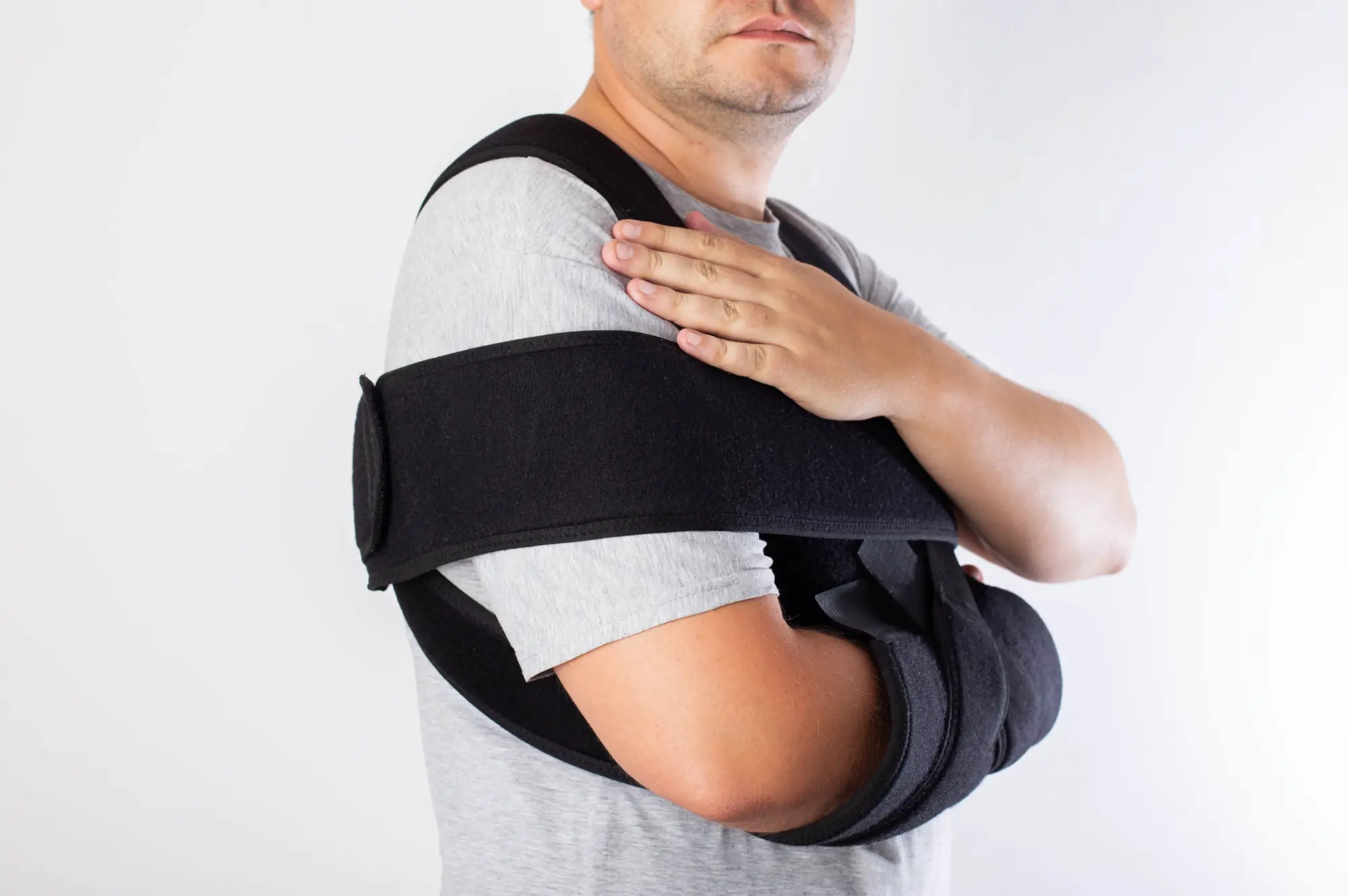
From your perspective, surgery and anesthesia are much the same as a standard shoulder replacement. Recovery follows the same general path as well, including a period in a sling and a course of physical therapy.
Recovery After Robotic Shoulder Replacement
The technology can help me place the implant, but it does not shorten the time your tissues need to heal. Recovery follows the same phased path as any shoulder replacement, and timing varies from person to person.
For the first several weeks, your arm is typically supported in a sling. Gentle passive motion, where a therapist moves the arm for you, usually starts early. From about six to twelve weeks, you begin moving the shoulder under its own power, and light strengthening is added gradually.
After that, strength, coordination, and endurance tend to keep improving over several months. Many people continue to see gains for up to a year. My reverse shoulder replacement recovery tips cover practical ways to get through each phase.
What the Technology Does Not Do
These tools report position and help reproduce a plan. They do not judge tendon quality, balance soft tissue, or decide how much bone is safe to remove. Those decisions stay with the surgeon.
Whether it is right for you depends on your shoulder, and that is a conversation for your evaluation.
Who Is a Candidate for Robotic Shoulder Replacement?
In general, if you are a candidate for shoulder replacement, you may be a candidate for a robotic or computer-guided approach. The technology does not change who needs a new shoulder. It changes how the operation is planned and carried out.
Most of my replacement patients fall into one of two groups. Some have arthritis with a rotator cuff that still works well, and they are usually suited to an anatomic replacement. Others have a cuff torn beyond repair, often with arthritis that follows it, called cuff tear arthropathy. They are usually better suited to a reverse replacement. I explain that choice in more detail in my post on anatomic vs. reverse shoulder replacement.
Guidance tends to matter most when precise positioning is hardest to judge by eye. That includes a socket that has lost bone or worn out of shape, or a previous replacement that needs revision. A more typical shoulder can still benefit from a careful 3D plan.
Whether this approach fits your shoulder is something we decide together at your evaluation, after I review your exam, X-rays, and CT scan.
What I See in My Patients
The Tampa Bay area sends me a particular kind of shoulder. Many of my patients have been swimming, golfing, and playing a great deal of pickleball for decades. By the time someone finally lets me scan the joint, that shoulder has often been arthritic for eight or ten years.
Arthritis that old almost never wears evenly. The humeral head drifts backward, the socket wears out posteriorly, and the glenoid ends up in significant retroversion. On a plain X-ray it can look like a fairly ordinary arthritic shoulder. On a 3D reconstruction it looks like a reconstruction problem.
Almost nobody arrives with a textbook glenoid, and the cases that look simplest on X-ray can still surprise you. Robotic shoulder replacement technology can be useful in these cases.
How I Decide When to Use It
How much guidance I use during the operation depends on what the shoulder requires. It may be especially helpful when the anatomy makes precise positioning particularly important: a significantly deformed glenoid, limited bone stock, a revision of a previous replacement, or an augmented component that needs to be positioned in a specific orientation. These are the cases where having the plan and the guidance in the room can make a meaningful difference.
Summary
Robotic shoulder replacement is less about a robot doing surgery and more about better planning and guidance. A 3D plan helps the surgeon understand your anatomy before surgery, and guidance tools help carry out that plan. The surgeon makes every decision in the operating room.
If you would like your shoulder evaluated, you can schedule a consultation at my Largo, St. Petersburg, Palm Harbor, or Sarasota office. Bring any prior imaging you have, including outside studies.
Frequently Asked Questions
Does a robot perform any part of my surgery?
No. Robotic and navigation systems guide or check instrument position, but the surgeon performs the operation and makes the decisions.
Will I need a CT scan before surgery?
For most shoulder replacement patients, yes. 3D planning depends on CT imaging, which shows socket wear more accurately than standard X-rays.
Is this used for every shoulder procedure?
It depends, but planning applies to shoulder replacement. Procedures such as shoulder arthroscopy rely on direct camera visualization instead, and they do not require this kind of guidance.