Medically reviewed by Scott Vizzi, M.D.
The sling is the part of recovery patients ask me the fewest questions about before surgery and the most questions about afterward. I understand why. Compared with the operation itself, wearing a sling after shoulder surgery sounds like the easy part. Then you get home. Now, figuring out how to move around and how to sleep becomes the challenge. In this post, I’ll explain why wearing a sling following shoulder surgery is important, as well as provide some tips for managing it.
Key Takeaways
- The sling protects a repair while it heals. This is why it stays on even after the pain improves.
- Fit matters. A sling worn wrong can cause neck pain, wrist swelling, and elbow stiffness that are entirely avoidable.
- Coming out of the sling is a decision we make together, and timing differs between individuals and procedures.
What the Sling Is Actually Doing
Patients tend to assume the sling exists to keep the arm comfortable. Comfort is a side effect. The real job is mechanical. When I repair a rotator cuff tendon to bone, or reconstruct a joint surface, the healing tissue cannot tolerate load in the early weeks. Muscles pull on that repair every time you use the arm. Reaching for a coffee cup, steadying a door, or letting the arm hang while you stand up all put tension across the very tissue I am asking to heal.
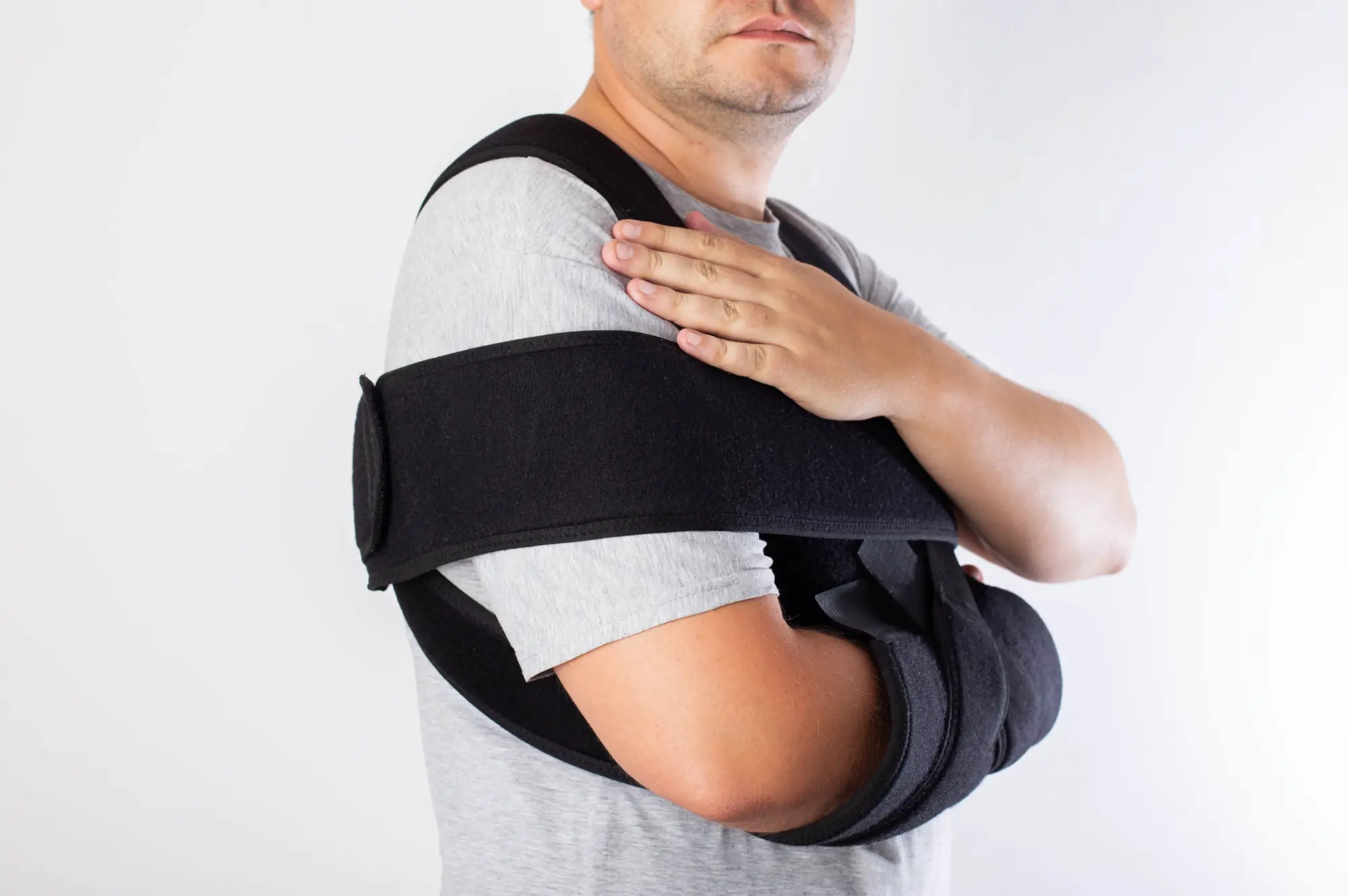
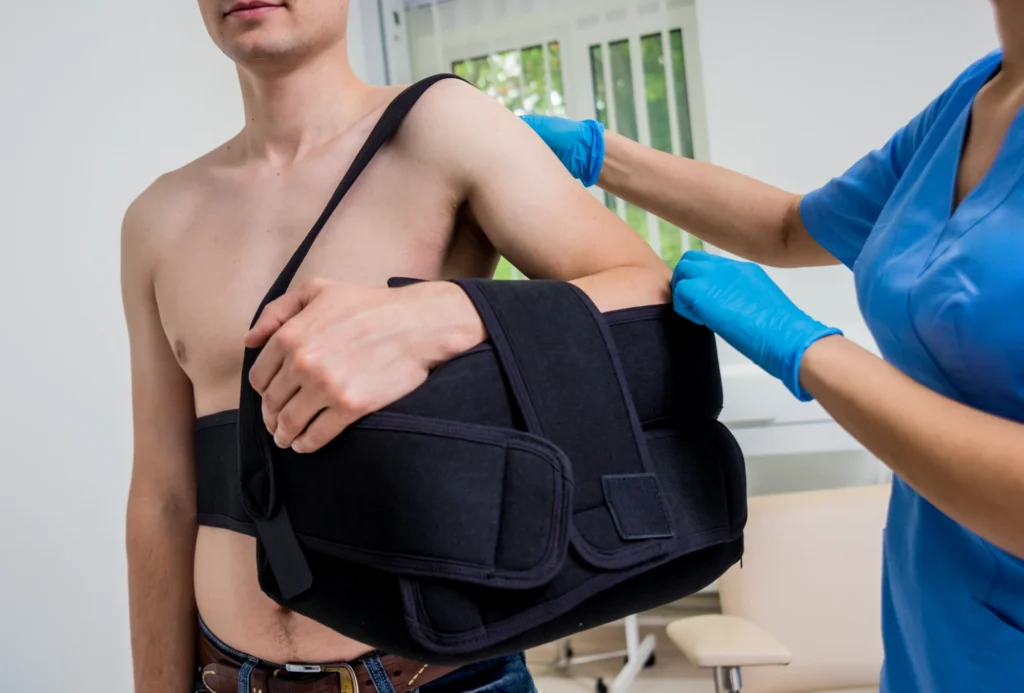
The sling removes that tension by taking the weight of the arm off the shoulder and holding the joint in a position where the repair sits relaxed. After some procedures, an abduction pillow gets added to hold the arm slightly away from the body, which takes further strain off a repaired tendon.
How Long to Wear a Sling After Shoulder Surgery
I resist giving a single number for how long you will be in the sling, because the honest answer depends on what was done inside your shoulder.
After a total shoulder replacement or a reverse shoulder replacement, the arm is typically supported in a sling for several weeks while gentle passive range-of-motion work begins early. Active motion generally follows in the six-to-twelve-week window, with light strengthening layered in after that.
After shoulder arthroscopy, the range is wider. A simple debridement or removal of an inflamed bursa may need only brief protection. A large rotator cuff repair or a labral repair asks for considerably more, and the tissue quality I found during surgery influences that call directly.
Your timeline comes from your operative report and your progress, not from what your neighbor experienced.
What I See in My Patients
Two failure modes account for most of the sling problems I encounter, and they sit at opposite ends of the same spectrum.
The first patient wears the sling perfectly and then some. They keep it on around the clock, never move the elbow, and guard the arm even while seated. At week six they arrive with a shoulder that is safe, protected, and stiff. Protection was never supposed to mean immobility. Passive motion inside the protected range is part of the plan for a reason.
The second patient feels good at ten days, decides they are ahead of schedule, and starts using the arm for small things. Those small things are the problem. Nobody re-tears a cuff repair bench pressing at three weeks. They re-tear it catching a dropped phone or bracing on the arm to get out of a low chair.
There is also a Florida-specific issue I bring up with every patient. Wearing a sling in this heat and humidity is miserable, and the skin underneath gets irritated fast. I would rather plan for that ahead of time than have someone abandon the sling over a rash in August.
Wearing It Correctly
Most slings are adjusted wrong on the first day and stay wrong until someone points it out.
Your elbow should sit at roughly ninety degrees, tucked comfortably at your side. The forearm needs support along its whole length, with the wrist level or slightly above the elbow. A wrist that dangles below the sling can swell within a day or two.
Your hand should rest slightly forward of your body rather than pressed across your stomach, and it should not be curled up against your chest. That small adjustment reduces internal rotation strain on the shoulder.
The strap should run across your back and opposite shoulder rather than pulling straight down on the side of your neck. Neck pain in the first postoperative week almost always traces back to strap position rather than to the surgery, and a small pad under the strap solves it in most cases.
For the heat, a thin cotton sleeve between your skin and the sling material helps a great deal. Owning two or three so you can wash them daily helps more. Keep the underarm clean and dry and check that skin regularly, particularly if an abduction pillow is holding the arm away from your body.
Sleeping, Showering, and Getting Dressed
Sleep can be the hardest part of the first two weeks, but there are strategies to make it easier. Many of my patients sleep better in a recliner for the first few weeks. No recliner? Prop your upper body on a wedge or several pillows, then tuck a small pillow or rolled towel under the operative elbow. Lying flat lets the arm fall backward and pull on the shoulder. That is why patients so often wake up hurting at two in the morning.
For showering, follow the wound care instructions you were given, since they depend on your specific incisions and dressings. Once you are cleared to shower, the general principle is to let the arm hang relaxed at your side while you stand, without actively lifting or reaching. Someone else can help you wash the operative side.
Dressing is easier if you always put the operative arm into the sleeve first and take it out last. Loose button-front or zip-front shirts make the whole thing more manageable.
Keep the Rest of Your Arm Moving
The shoulder rests. The rest of the limb should not.
My instructions and your physical therapist’s plan will spell out exactly what to do, but plan to open and close your hand regularly, bend and straighten your elbow through its full range several times a day, and rotate your wrist. It takes a couple of minutes and prevents the elbow stiffness and hand swelling that otherwise become their own separate problem during rehab.
Patients who skip this step often spend part of their therapy time regaining elbow motion they never needed to lose.
How I Set a Timeline for Your Sling
What I find once I am inside the shoulder gives me more information on how much protection the repair needs. For example, a tendon that is healthy and mobile behaves differently than a tendon that is thin and degenerated. My findings set how conservative I am with the sling.
From there I progress people on what the shoulder is doing rather than purely by the calendar. If you are unsure whether you can go without the sling at your desk job, call and ask. Two minutes on the phone beats an unplanned setback at week five.
Summary
Wearing a sling after shoulder surgery is a protective job with a defined purpose, a real duration, and a right and a wrong way to do it. Fit it properly, keep your elbow and hand moving, plan your sleep before you need to, and resist the temptation to use the arm for small tasks once the pain fades.
If you are preparing for shoulder surgery or you are struggling with your sling right now, reach out to my office rather than working it out alone. We can usually fix a fit problem in a few minutes, and a small adjustment early is far easier than undoing weeks of a bad habit.
Frequently Asked Questions
Do I have to sleep in the sling?
For most procedures, yes, at least in the early weeks. Sleep is when the arm is most likely to fall into a position that stresses the repair. I will tell you at a follow-up visit when nighttime use can stop.
Can I take the sling off to shower?
Generally yes, once you have been cleared to shower, with the arm hanging relaxed at your side and no active lifting or reaching. Follow the wound care instructions you were given, since those depend on your incisions.
What happens if I use my arm too early?
Early loading can stretch or disrupt a healing repair. Depending on the procedure and the timing, that may compromise the result or require revision surgery. This is the main reason the sling stays on as long as it does.
My neck hurts more than my shoulder. Is that normal?
It is common, and it usually reflects strap position or a sling adjusted too tightly rather than a problem with the surgery. Reposition the strap across your back, add a pad, and let my office know if it persists.