
Medically reviewed by Scott Vizzi, M.D. | Reviewed July 2026
Having covered multiple athletic organizations (and currently covering the Toronto Blue Jays), I’ve seen countless pitchers walk off the mound holding their shoulder. Shoulder injuries in baseball pitchers are different from most of what I treat, because the throwing shoulder is asked to move faster and rotate further than almost any other joint in the body. I see this pattern at every level, from a fourteen-year-old traveling in for a weekend tournament to a professional pitcher trying to get through a long season. Many throwing shoulder problems respond well to the right diagnosis and the right plan, and in my experience, surgery is rarely the first step.
Key Takeaways
- Shoulder injuries in baseball pitchers usually build up from repetitive stress rather than a single hit or fall.
- The rotator cuff and labrum are the two structures I check first in any throwing athlete.
- Many throwing shoulder problems improve with mechanics correction, rest, and targeted strengthening.
- A return-to-throwing program should be gradual and supervised, not rushed to meet a schedule.
Why a Pitcher’s Shoulder Breaks Down Differently
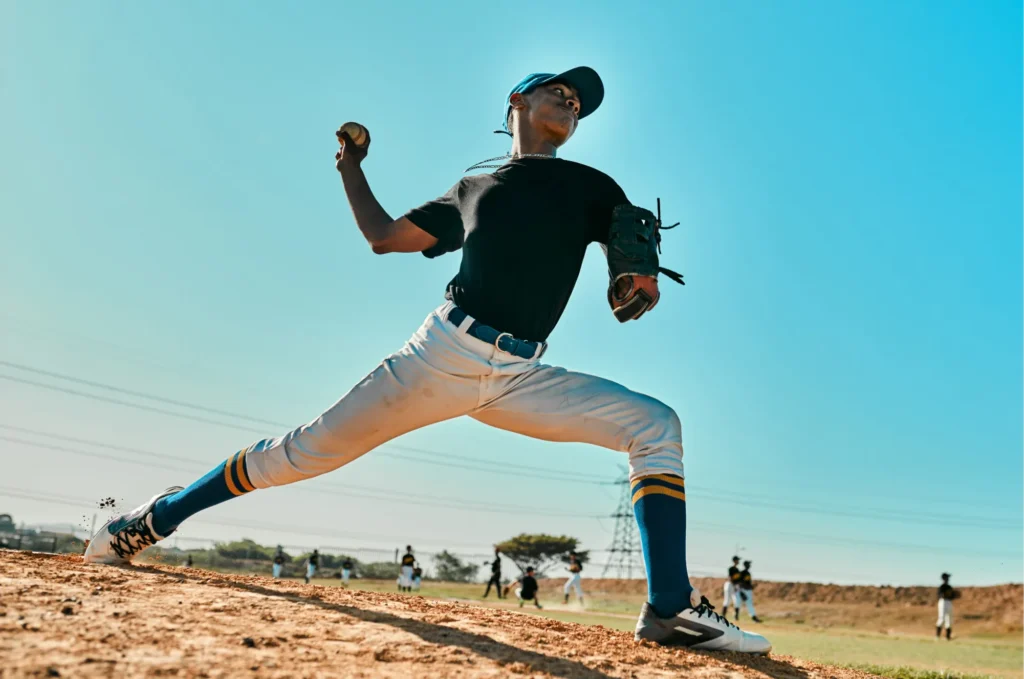
A throwing shoulder is built for mobility, and pitching pushes that mobility close to its limit. The late cocking phase of a pitch places the shoulder in extreme external rotation, then asks it to decelerate an arm moving at a high rate of speed a fraction of a second later. Over thousands of repetitions across a season, this can lead to increased external rotation, tightening of the back of the joint capsule, and imbalance between the internal and external rotator muscles.
None of that is abnormal on its own. Adaptation is part of what allows a pitcher to throw hard in the first place. I think the mistake is assuming that because an adaptation is common, it is automatically safe. A shoulder that has lost internal rotation or developed scapular dyskinesis is a shoulder working with less margin for error, and that is usually where I start looking when a pitcher comes in with new pain.
I also pay close attention to workload. Pitch counts, innings across a season, and how much rest an arm gets between outings all factor into how much stress accumulates in the shoulder over time. A pitcher who throws a heavy schedule of showcases, travel tournaments, and a school season back-to-back rarely gets the recovery window the tissue needs. I bring this up early in almost every consultation, because it is often the single most fixable part of the problem.
The Injuries I See Most Often in Throwing Shoulders
Rotator Cuff Tendinopathy and Partial Tears
Repetitive overhead loading places cumulative stress on the rotator cuff, and throwers tend to develop partial tears on the undersurface of the tendon, an area that takes on high stress during the throwing motion. Pitchers usually describe this as a loss of velocity or command before they describe pain, which is why I ask about performance changes as carefully as I ask about symptoms.
Labral Tears and SLAP Lesions
SLAP tears involve the upper labrum near the biceps attachment and show up often in throwing athletes. The pain tends to sit deep in the shoulder, and some pitchers describe a dead arm sensation or a loss of control on their breaking pitches. Labral pathology can be subtle on exam. I sometimes order an MRI with contrast, an arthrogram, because it improves visualization of labral injuries compared to a standard MRI.
Internal Impingement and Microinstability
Some throwers develop a pattern where the rotator cuff and labrum get pinched between the humeral head and the glenoid in the extreme external rotation position of a pitch. This is closely tied to the laxity that lets a pitcher throw hard in the first place, which is exactly why I do not treat every loose shoulder the same way I would treat a contact athlete’s shoulder. A certain amount of laxity is normal, even useful, in a throwing shoulder. The question I am really asking during an exam is whether that laxity has crossed into instability that is actually limiting performance or causing pain, because the treatment for those two situations looks very different.
What I See in My Patients
The high school and travel-ball pitchers I see around Tampa Bay throw more competitive innings by age fifteen than a lot of my colleagues threw by the time they finished college ball, and I think that volume is a bigger driver of injury than most families expect. Parents are often surprised when I tell them the fix is fewer pitches and better mechanics. Working with the Blue Jays has shaped how I think about this too. At the professional level, workload is tracked closely and mechanics are coached constantly, and that same discipline applied earlier in a career prevents a lot of the injuries I end up treating surgically later on.
My Approach to Treatment
I start almost every throwing shoulder evaluation the same way: a detailed history of pitch counts, mechanics, and when the pain shows up in the throwing motion, followed by a physical exam that looks closely at rotation, scapular control, and strength. Imaging comes after that. For many pitchers with tendinopathy or a partial tear, I recommend rest from throwing, correction of mechanics with a throwing coach or physical therapist familiar with sports shoulder demands, and a strengthening program built around the rotator cuff and scapular stabilizers.
When a pitcher has significant structural damage that has not responded to a real course of conservative care, I may discuss arthroscopic surgery as an option. I am conservative about recommending surgery in throwers, partly because the return-to-sport process after a repair is longer and less predictable than most families expect, and I would rather exhaust the non-surgical path first when it is reasonable to do so.
Getting Back to the Mound
Return to competitive throwing after a shoulder injury should follow a structured progression rather than a fixed calendar. In general, I think about it in phases: protecting the healing tissue while maintaining conditioning through the lower body and core, gradually restoring motion and strength, advancing through a structured throwing program that rebuilds distance and intensity in steps, and finally clearing a pitcher based on functional testing rather than how the shoulder simply feels that day.
That last phase matters more than families usually expect. A pitcher can feel completely fine at sixty feet and still not be ready to throw off a mound at full intensity. I would rather have a conversation about pushing the timeline back two weeks than have a conversation about a setback that costs an entire season. Specific timelines vary quite a bit depending on the injury, the level of competition, and how the shoulder responds along the way, and I adjust the plan as we go rather than sticking to a number I gave at the first visit.
Summary
Shoulder injuries in baseball pitchers rarely announce themselves with one dramatic moment. They tend to build quietly through a season, showing up first as a drop in velocity before pain becomes the main complaint. If you have noticed a change, I would rather see you for an evaluation sooner than later. Schedule a consultation and let’s look at what is actually happening in the shoulder before it costs a season.
Frequently Asked Questions
How do I know if a pitcher’s shoulder pain is serious?
Pain that lingers after a start, changes in velocity or command, or any sensation of the arm feeling dead or unstable are all reasons to be evaluated. I would rather see a pitcher early than after weeks of pitching through discomfort.
Can shoulder injuries in baseball pitchers heal without surgery?
Many can. Tendinopathy, many partial rotator cuff tears, and some labral irritation often respond to rest, mechanics work, and a targeted strengthening program built around the rotator cuff and scapular stabilizers. Surgery becomes part of the conversation when structural damage is significant or when conservative care has genuinely been tried, over a real length of time, and has not worked.
What imaging do you use to diagnose a throwing shoulder injury?
I typically start with a thorough physical exam, then use standard MRI or, in select cases where labral injury is suspected, an MRI arthrogram, which tends to show labral detail more clearly.
When should a young pitcher stop throwing and see a doctor?
Any pain during or after throwing that does not resolve within a day or two, a drop in velocity, or a change in arm slot or mechanics are all worth a visit. Playing through shoulder pain is one of the more common paths I see to a bigger injury later.
How long does the return-to-throwing process usually take?
It depends heavily on the diagnosis and how the shoulder responds to treatment. A structured throwing program alone can take several weeks to progress safely, and that timeline extends further if surgery is part of the treatment plan.