
Medically reviewed by Scott Vizzi, MD | Reviewed June 2026
If you’ve been told you have a labral tear, you probably have a lot of questions. What exactly is a labral tear in the shoulder? Why does it cause so much pain or that strange “dead arm” sensation? And what does treatment actually look like? These are the questions I hear most often in my practice, whether I’m seeing a competitive baseball pitcher here in the Tampa Bay area or a weekend paddleboarder who caught their arm in a fall. I want to walk you through what I actually see, how I think about it, and what you can reasonably expect from treatment.
Key Takeaways
- The labrum is a ring of cartilage that deepens the shoulder socket and gives the joint stability. A tear disrupts that stability.
- Labral tears can happen from a single trauma (like a dislocation) or build up gradually from repetitive overhead activity.
- SLAP tears (a specific type involving the top of the labrum near the biceps) are especially common in throwing athletes.
- Many labral tears respond well to non-surgical treatment. Surgery may be considered when instability or pain persists despite appropriate rehabilitation.
What Is the Labrum, and Why Does It Matter?
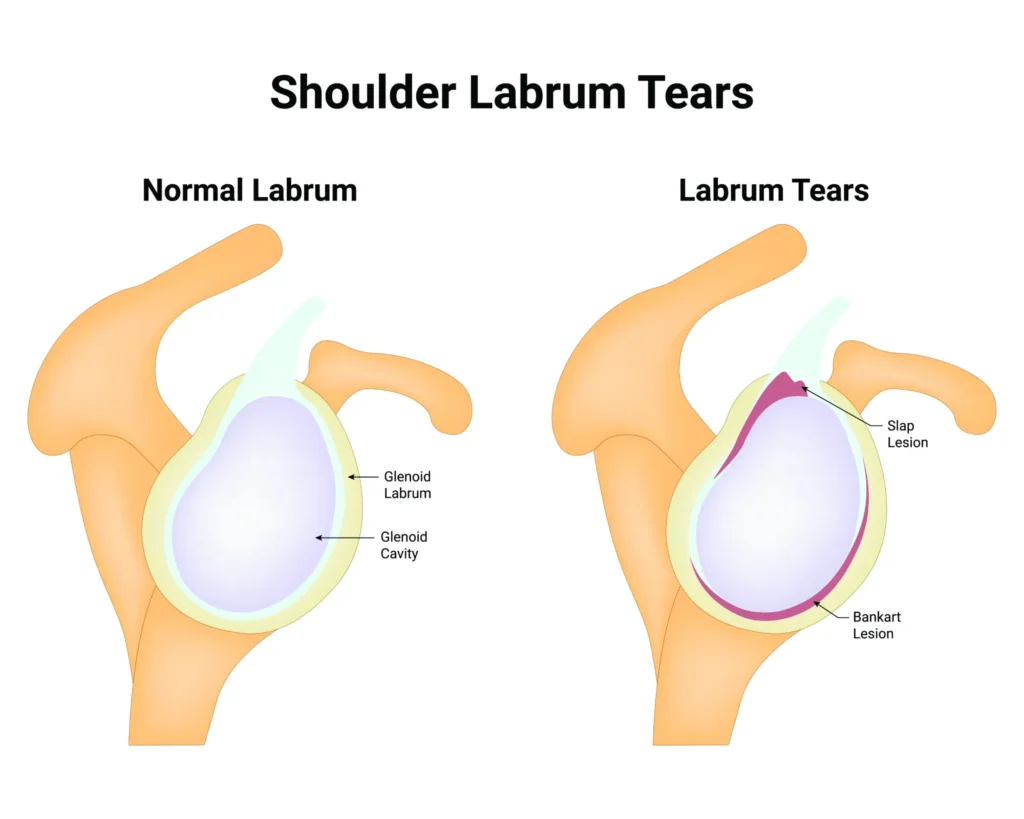
The shoulder is a ball-and-socket joint, but the socket itself is surprisingly shallow. On its own, the bony socket (called the glenoid) only covers a small portion of the ball (the humeral head). The labrum is a ring of fibrocartilage that attaches around the rim of that socket, effectively deepening it and increasing the surface area for contact. Think of it like a rubber gasket that helps keep the ball seated in place.
Beyond stability, the labrum serves as an attachment point for several important ligaments and for the long head of the biceps tendon. When the labrum tears, those attachments can be compromised, which is part of why shoulder labral tears can cause such a wide range of symptoms, from dull aching to instability.
Types of Shoulder Labral Tears
Not all labral tears are alike. Where the tear occurs around the labrum largely determines both the symptoms a patient experiences and the treatment approach.
SLAP Tears
SLAP stands for Superior Labrum Anterior to Posterior. These tears involve the upper portion of the labrum, at the point where the biceps tendon attaches. They’re particularly common in overhead throwing athletes, and I see them regularly in players who put high rotational stress through the shoulder repeatedly over a season. The deep shoulder pain during throwing, combined with a sense of decreased velocity or “something feels off,” is a classic presentation for a SLAP lesion.
Bankart Lesions (Anterior Labral Tears)
A Bankart lesion is a tear of the front (anterior) portion of the labrum. This is the most common injury pattern following a shoulder dislocation. When the shoulder dislocates forward, the humeral head can shear off the front of the labrum as it exits the socket. Patients with Bankart lesions often describe a feeling of apprehension, a sense that the shoulder might “go out again” in certain positions.
Posterior Labral Tears
Posterior labral tears affect the back of the labrum and can occur from repetitive internal rotation loading, such as in football linemen or weightlifters who perform heavy bench pressing. They tend to be subtler than anterior tears and can sometimes be mistaken for other causes of posterior shoulder pain.
What Causes a Labral Tear?
Labral tears generally result from one of two mechanisms: acute trauma or cumulative stress. An acute event, such as a shoulder dislocation, a fall on an outstretched arm, or a direct impact during contact sport, can tear the labrum in a single moment. Cumulative stress tears develop more gradually. Repeated overhead throwing, swimming, or other overhead activities place cyclical load on the labrum over time, and small injuries can accumulate into a meaningful tear before the athlete is even aware of a problem developing.
Age can also play a role. In patients over 40, labral tears are sometimes found incidentally on imaging and may reflect degenerative change rather than a specific injury.
Symptoms That May Signal a Labral Tear
Symptoms can vary depending on where the tear is and what caused it. That said, a few patterns come up regularly in my office.
Deep shoulder pain during overhead activity is one of the most common complaints. Patients usually describe it as being “inside” the joint rather than on the surface. A clicking, catching, or grinding sensation with movement may also be present, though not everyone with a labral tear has these sounds.
Instability or apprehension is particularly telling. Patients with anterior labral tears often feel the shoulder might “slip out” when the arm is raised and rotated outward. Throwers with SLAP lesions may describe a “dead arm”: a sudden loss of power or feeling of weakness mid-throw that’s hard to ignore once it starts.
Nighttime pain and difficulty sleeping on the affected side can also occur. In athletes, a noticeable drop in velocity, accuracy, or endurance during sport often prompts the evaluation.
How I Evaluate a Suspected Labral Tear
Diagnosing a labral tear requires more than just ordering an MRI. I spend time during the initial visit gathering a detailed history: when did the pain start, what sport or activity is involved, did any specific event trigger symptoms, and how has the shoulder behaved since? The physical exam includes specific provocative tests designed to stress the labrum and reproduce symptoms in a controlled way.
Imaging plays an important role, but it has to be interpreted carefully. Standard MRI can miss some labral tears, particularly subtle SLAP lesions. When I have a high clinical suspicion, I often order an MRI arthrogram, which involves injecting contrast material into the joint before imaging. This improves the ability to visualize the labrum and identify tears that might not be visible on a routine study.
What I See in My Patients
In my practice here in the Tampa Bay area, I see labral tears across a wide spectrum of patients. A portion are athletes, particularly baseball players, given my work as a team physician for the Toronto Blue Jays. Overhead throwing athletes develop very specific adaptations in shoulder range of motion over time, and those adaptations can increase stress on the labrum in ways that gradually accumulate.
But I also see plenty of non-athletes. Active adults who paddleboard, do CrossFit, play recreational tennis, or simply catch themselves in a fall can tear the labrum just as significantly. Florida’s active outdoor culture means we see people who push their shoulders hard well into their 50s, 60s, and beyond.
My Approach to Treatment
My starting point is almost always conservative, non-surgical management. A structured physical therapy program targeting shoulder mechanics, rotator cuff strength, and kinetic chain deficits can allow many patients to return to full activity without surgery. Rest from aggravating activities, targeted strengthening, and gradual return to sport form the backbone of that approach. In some cases, platelet-rich plasma (PRP), a regenerative medicine treatment, may be considered.
How long to pursue non-surgical treatment depends on the type of tear, the severity, the patient’s activity level, and how they’re responding.
When surgical treatment is appropriate, I perform arthroscopic labral repair. Through small incisions, I use a camera and specialized instruments to reattach the torn labrum back to the socket using suture anchors. The arthroscopic approach allows detailed visualization of the joint and minimizes disruption to the surrounding tissue. You can read more about how I use shoulder arthroscopy to treat a range of shoulder conditions on my site.
The decision to operate is never one I make for a patient. I lay out the options, explain the risks and expected outcomes, and let each person decide based on their own goals and lifestyle. A 22-year-old competitive pitcher has different needs and expectations than a 55-year-old recreational tennis player, and the treatment plan should reflect that.
Labral Tears in Athletes: Special Considerations
Treatment decisions in athletes require an understanding of the sport’s physical demands, the athlete’s competitive level, and their season timing. My experience working with professional baseball, football, and collegiate programs informs how I approach these conversations. The goal is never just to fix the shoulder in isolation: it’s to get the athlete back to performing at their level safely and durably.
For younger athletes who sustain a dislocation, recurrence risk is a concern. In a high-school or college athlete with a first-time dislocation and confirmed Bankart tear, the likelihood of recurrence with conservative treatment alone can be significant. That’s a conversation worth having early, before the shoulder gives out a second or third time.
Summary
A shoulder labral tear can range from a mild nuisance to a major source of instability and pain, depending on its location, size, and the demands you place on your shoulder. The most important thing I want patients to take away from this article is that a labral tear is treatable, and in many cases without surgery.
If you’re experiencing shoulder pain, instability, a clicking or catching sensation, or a drop in athletic performance, I’d encourage you to schedule an evaluation at one of my offices in St. Petersburg, Largo, Palm Harbor, or Sarasota. The sooner we understand what’s going on, the sooner we can build a plan that gets you back to what you love doing.
Frequently Asked Questions
How is a labral tear diagnosed?
Diagnosis involves a combination of physical examination and imaging. A standard MRI may identify many tears, but an MRI arthrogram (with contrast injected into the joint) may provide better visualization, particularly for SLAP lesions and smaller tears. The clinical exam remains essential because imaging findings always need to be interpreted in the context of the patient’s symptoms and functional limitations.
What is the difference between a labral tear and a SLAP tear?
A SLAP tear is a specific type of labral tear. While “labral tear” refers to any tear in the ring of cartilage around the shoulder socket, a SLAP tear specifically involves the superior (upper) labrum, anterior to posterior, at the point where the biceps tendon attaches. SLAP tears are particularly associated with overhead throwing athletes and can produce the classic “dead arm” symptom.
Do I need surgery for a labral tear?
Not necessarily. Many labral tears, particularly those without significant instability, can be managed successfully with non-surgical treatments. Surgical repair is typically considered when instability persists despite appropriate non-surgical treatment, when there is recurrent dislocation, or when the tear is significantly affecting an athlete’s ability to perform at their level. The right answer depends on the type of tear, your activity level, and your treatment goals.
How long does recovery take after labral repair surgery?
Recovery after arthroscopic labral repair generally progresses through a series of phases, from protecting the repair in a sling to gradually restoring motion, rebuilding strength, and returning to sport-specific activity. Timelines vary depending on the type and location of the repair, the individual’s healing, and the demands of the sport or activity. Return to high-level overhead sport tends to take longer than return to non-overhead activities and requires functional clearance rather than simply meeting a time-based milestone.